This page explains the control philosophy for water source heat pumps (also called simultaneous heat pumps). For the main page on advanced control logic for production units, see Advanced control logic for Generation III templates within the Hysopt Inspiration Library.
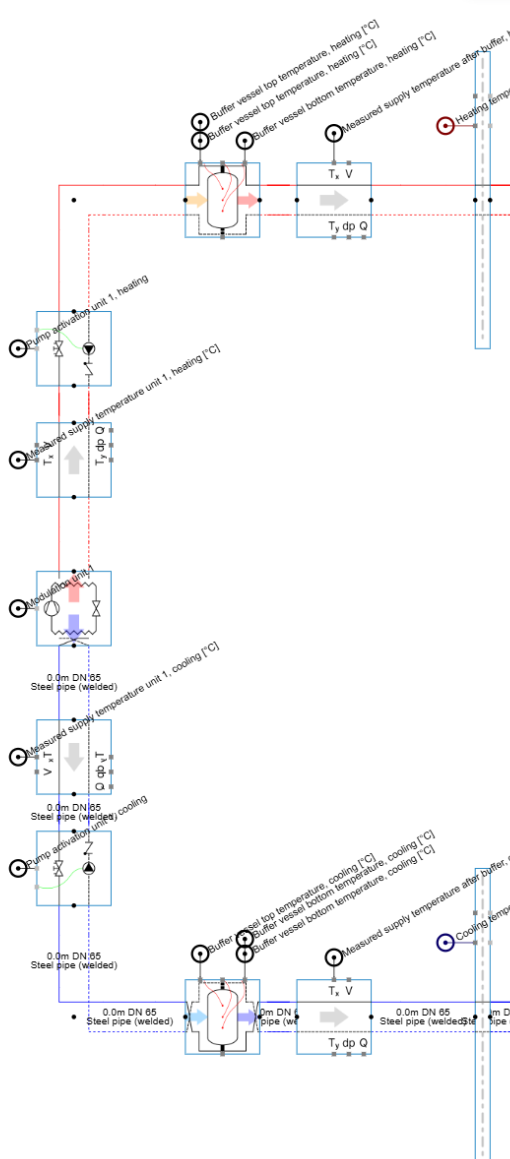
Water source heat pumps operate simultaneously in heating and cooling mode. Because these heat pumps normally require both heating and cooling demand to operate, the controller determines the prioritised operating mode and whether unused heating or cooling can be rejected through cooling towers, dry coolers, or other dump units. The control logic also determines when an activation signal and a modulation signal must be sent to each production unit.
Simultaneous heat pump control philosophy
Simultaneous heat pumps must operate in both heating and cooling mode. Their control strategy similar is similar to reversible heat pumps (see: Control philosophy for reversible heat pumps), but includes additional logic for heat dump availability. The controller determines the prioritised operating mode and whether unused heating or cooling can be rejected through cooling towers, dry coolers, or other dump units.
Input field
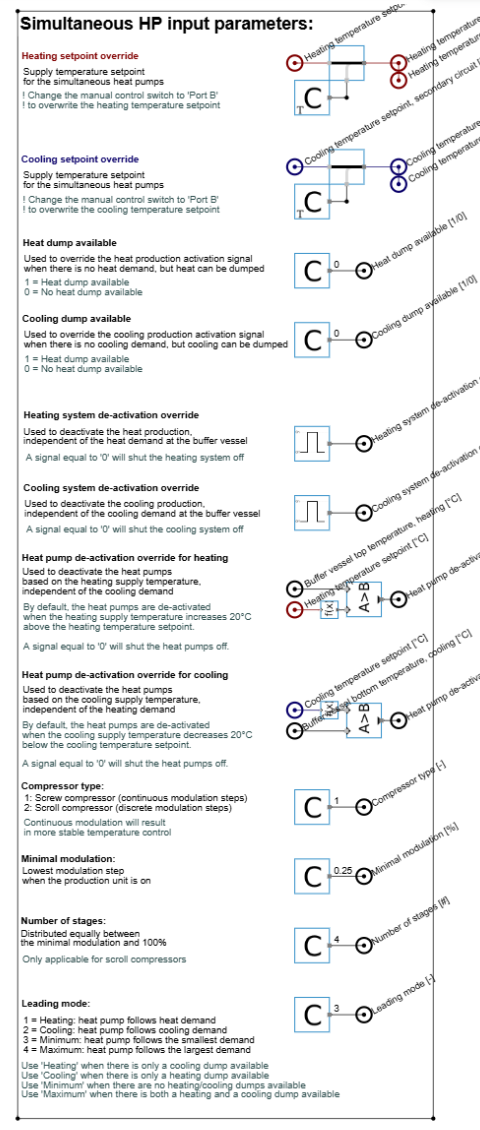
Simultaneous heat pump templates use the same input parameters as one-mode heat pump templates, but most parameters are duplicated because the controller must consider both heating and cooling operation. As such, the user can tune the simultaneous heat pump control behaviour through the input fields with the parameters: setpoint override for heating, setpoint override for cooling, deactivation override for heating, deactivation override for cooling, compressor type, minimum modulation & number of stages. A detailed description of these parameters can be found here: Control philosophy for heat pumps & chillers operating in one mode only.
In addition, simultaneous heat pumps include three extra input parameters:
-
Heat or cooling dump available: without a dump, the simultaneous heat pump can only operate when both heating and cooling demand are present. In that case, the heat pump will not deliver heating or cooling in the prioritised mode if there is no demand in the non-leading mode. If a cooling tower, dry cooler, or similar dump unit is connected, this should be defined as an available dump. The heat pump can then ignore the demand signal in the non-leading mode and assume that the unused heating or cooling is rejected through the dump.
-
Heat pump deactivation override for heating or cooling: this parameter acts as a safety trigger to avoid temperatures that are too high or too low in the non-leading heating or cooling circuit. Even when a dump is available, the heat pump is deactivated if the difference between the measured temperature and the temperature setpoint exceeds the defined offset. By default, this offset is set to an extreme value: +20 °C in heating mode and -20 °C in cooling mode. This prevents unintended deactivation during normal operation when this parameter is not in use.
-
Leading mode: unlike air source heat pumps, a water source heat pump cascade can only have one leading mode. In heating mode, the controller focuses on the heating circuit and ensures that the heating temperature setpoint is reached, without checking whether the cooling temperature setpoint is reached or exceeded. In cooling mode, the same principle applies to the cooling circuit. In Minimum mode, the controller considers both circuits and operates at the lowest required power until either the heating or cooling setpoint is reached, helping to avoid setpoint overshoot. In Maximum mode, the controller also considers both circuits, but operates at the highest required power until both setpoints are reached, even if one setpoint is exceeded. Use Minimum mode when no dumps are available. Use Maximum mode when dumps are available on both the condenser and evaporator sides. If a dump is only available on the condenser side, use Cooling mode. If a dump is only available on the evaporator side, use Heating mode.
Programmable controller
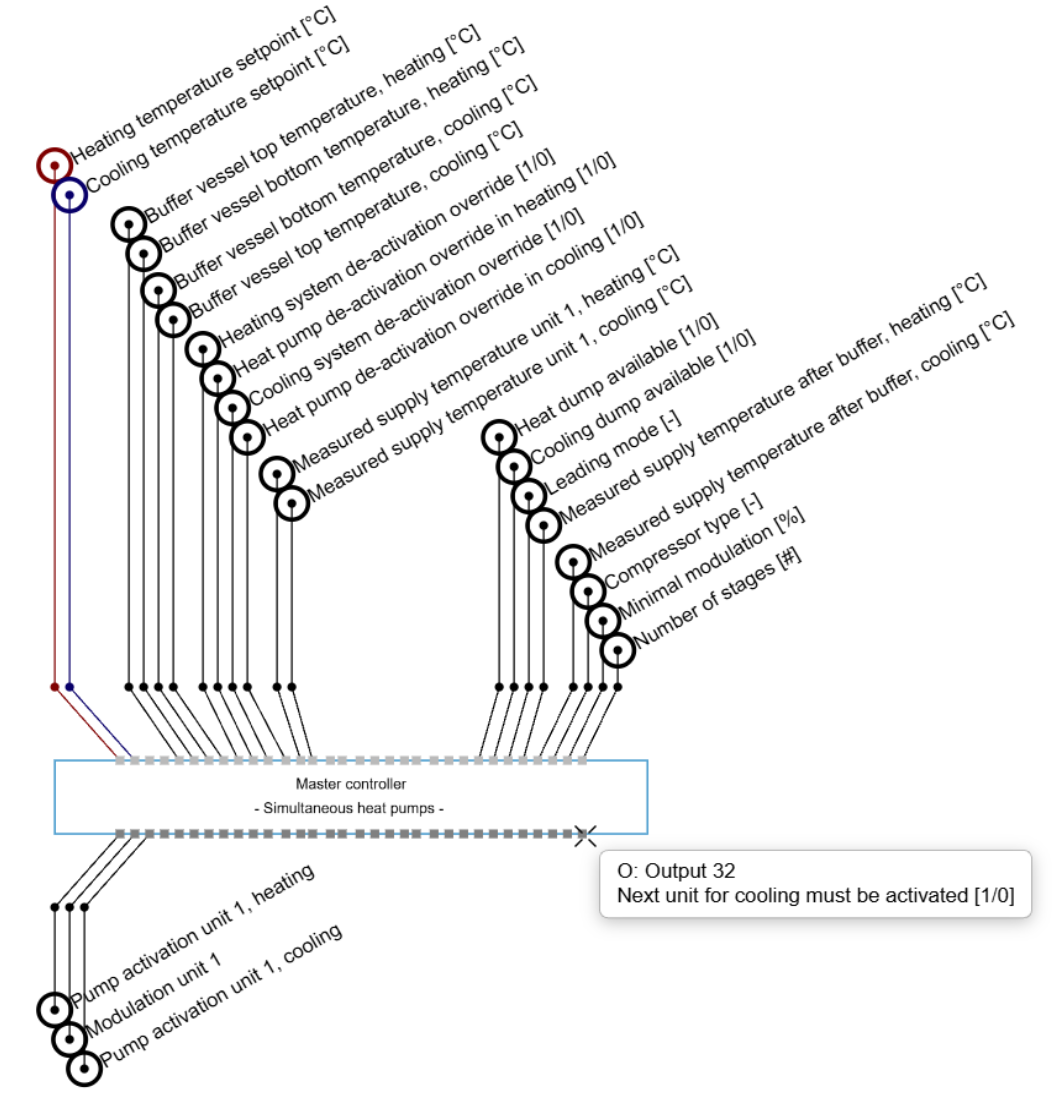
The programmable controller for simultaneous heat pumps works in a similar way to the controller for one-mode heat pumps (see also: Control philosophy for heat pumps & chillers operating in one mode only), but setpoints and input parameters are required for both heating and cooling. Because the number of inputs is higher, simultaneous heat pump controllers can only support a cascade of up to five units. If more units are required, use the Cascade logic control outputs to activate an additional controller.
Compared with one-mode heat pumps, simultaneous production units have one additional input related to the leading mode of the unit cascade. All units have the same priority.
Note that simultaneous production units have two dedicated output parameters per unit related to the activation of the heating side and the cooling side of the unit, but only one output parameter per unit related to the unit’s modulation signal. As the simultaneous heat pump provides heating & cooling simultaneously, the modulation signal will be determined in function of the cascade’s leading mode.
As with one-mode heat pumps, simultaneous heat pumps have two output parameters per mode related to the activation of the final production unit in the cascade and the activation signal for the next production unit or cascade.