This page explains the control philosophy for reversible heat pumps. For the main page on advanced control logic for production units, see Advanced control logic for Generation III templates within the Hysopt Inspiration Library.
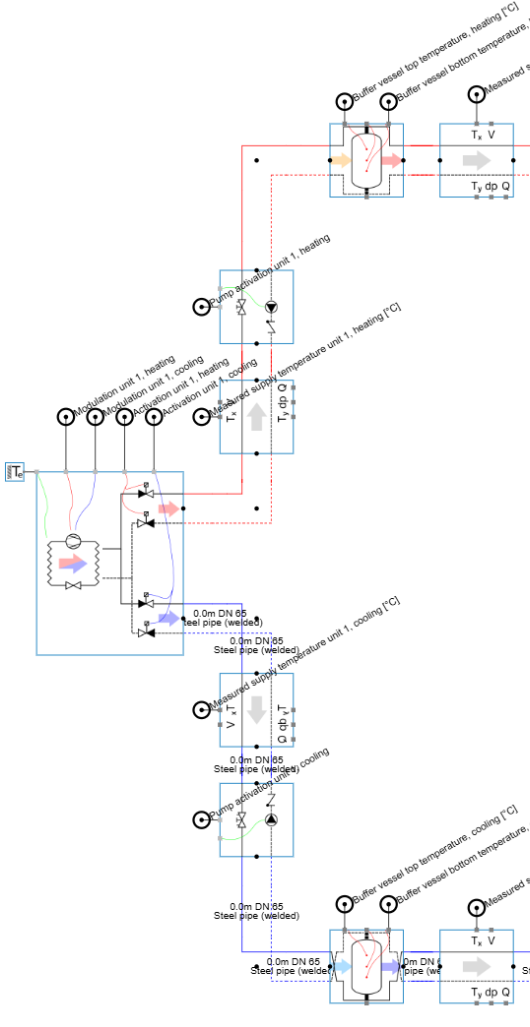
Reversible air source heat pumps can operate in both heating and cooling mode, but only at one mode at the time. When the heat pump operates in heating mode, the cooling side must be deactivated, and vice versa. The advanced control logic determines what mode must be activated, and when an activation signal and a modulation signal must be sent to each production unit.
Reversible heat pump control philosophy
Reversible heat pumps can operate in both heating and cooling mode. Their control strategy is similar to the strategy used for one-mode heat pumps (see: Control philosophy for heat pumps & chillers operating in one mode only), but includes additional logic to determine the active operating mode. If both heating and cooling demand are present at the same time, the controller uses the selected priority mode to determine which demand is served.
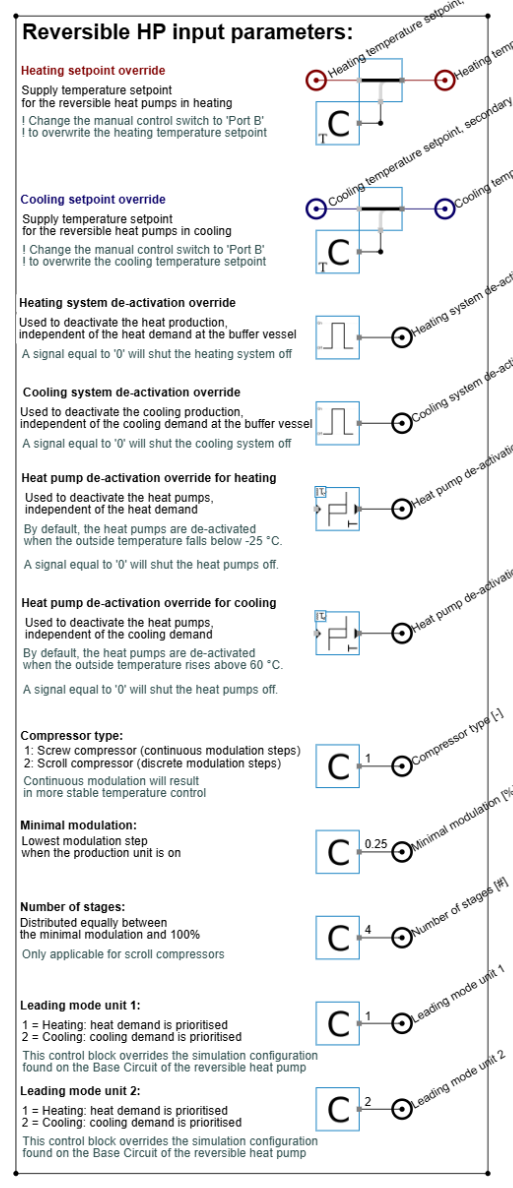
Input field
Reversible heat pump templates use the same input parameters as one-mode heat pump templates, but most parameters are duplicated because the controller must consider both heating and cooling operation. As such, the user can tune the reversible heat pump control behaviour through the input fields with the parameters: setpoint override for heating, setpoint override for cooling, deactivation override for heating, deactivation override for cooling, heat pump deactivation override for heating, heat pump deactivation override for cooling, compressor type, minimum modulation & number of stages. A detailed description of these parameters can be found here: Control philosophy for heat pumps & chillers operating in one mode only.
In addition, reversible heat pumps include one extra input parameter:
-
Leading mode unit X: this parameter determines whether heating or cooling is prioritised for a specific production unit. When heating is prioritised, the heat pump can only operate in cooling mode if there is no heat demand, or if the unit is not required in heating mode within the production cascade. In a cascade, each production unit has its own leading mode parameter.
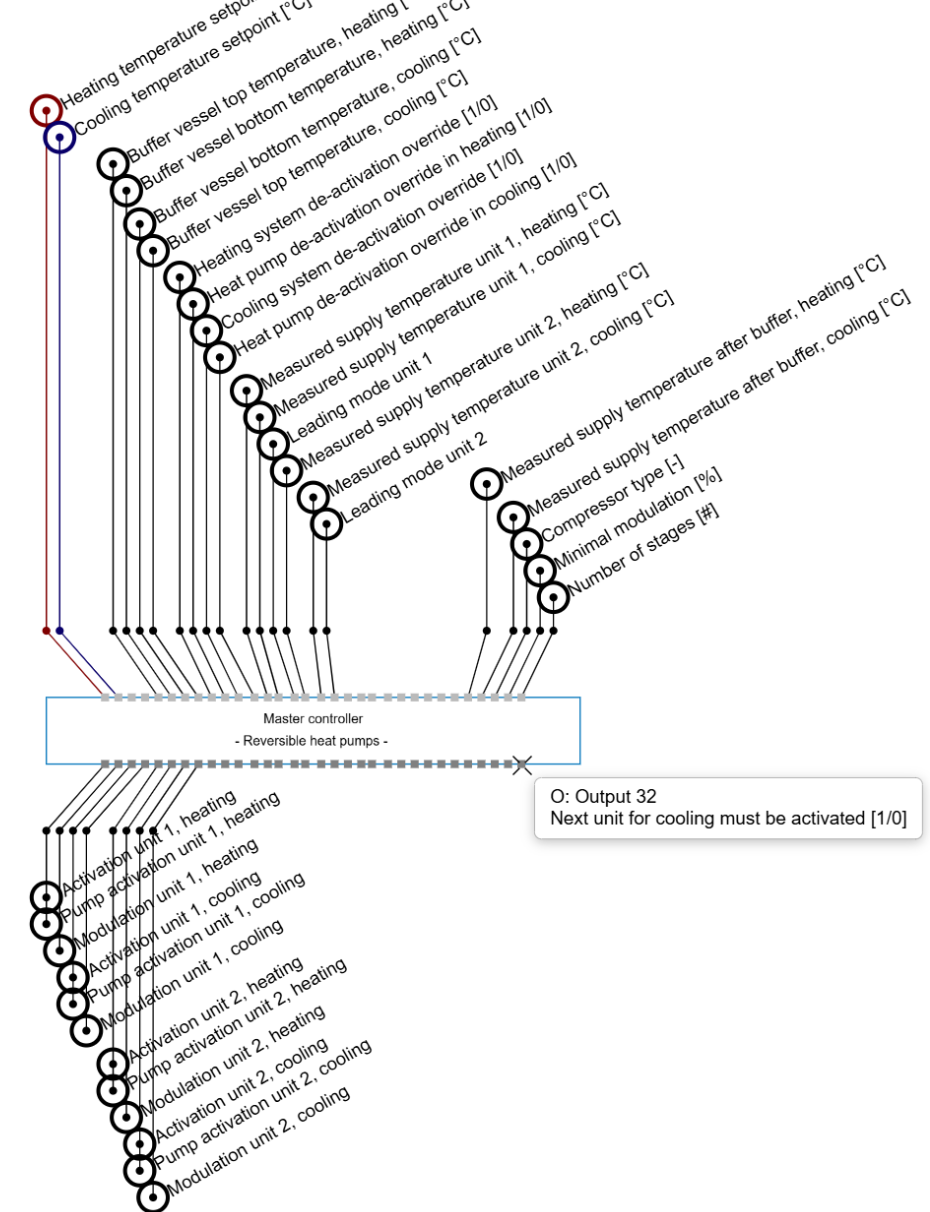
Programmable controller
The programmable controller for reversible heat pumps works in a similar way to the controller for one-mode heat pumps (see also: Control philosophy for heat pumps & chillers operating in one mode only), but setpoints and input parameters are required for both heating and cooling. Because the number of inputs is higher, reversible heat pump controllers can only support a cascade of up to five units. If more units are required, use the Cascade logic control outputs to activate an additional controller.
Compared with one-mode heat pumps, reversible production units have one additional input related to the leading mode of the unit. The automated controller uses an internal cascade hierarchy for heating and cooling priority. Heating priority is applied from top to bottom, meaning that the first production unit in the cascade is considered the leading unit in heating mode. Cooling priority is applied from bottom to top, meaning that the last production unit in the cascade is considered the leading unit in cooling mode. If different reversible heat pumps in a cascade have different priorities, connect the heat pumps so that the top units have heating priority and the bottom units have cooling priority.
As with one-mode heat pumps, reversible heat pumps have two output parameters per mode related to the activation of the final production unit in the cascade and the activation signal for the next production unit or cascade.